Secondary Procedures Lost in the Operative Note
A second repair, a graft or a separate compartment gets dictated deep in the note and never reaches the claim. Once a claim goes out short, nobody looks back.


Orthopedic billing services are the surgical coding, modifier logic, global period tracking and payment recovery work that turn every operative note and clinic visit into fully paid revenue. Nevada Medical Billing provides them for orthopedic surgeons, sports medicine and spine practices in Las Vegas, Henderson, Reno and statewide, with a 98% first-pass clean claim rate.
Every procedure captured from the operative note. Every modifier defended. Every workers' comp and lien dollar pursued to the finish.
We review 90 days of surgical claims, global period visits and remittances, then show you the dollars your practice is owed. No contract. No obligation.
Orthopedic claims are some of the most valuable in medicine and some of the easiest to underpay. A clean-claim dashboard can look healthy while money leaks out at the edges. These are the seven leaks we find most often.
A second repair, a graft or a separate compartment gets dictated deep in the note and never reaches the claim. Once a claim goes out short, nobody looks back.
A chondroplasty (29877) billed with a meniscectomy (29881) on the same knee pays nothing extra, because 29881 already includes it. Billing it anyway invites a denial now or a recoupment later.
A missing 79 on an unrelated return to the OR, a 25 on a visit that was not separately identifiable, or an unsequenced 51 lowers the payment, or erases it.
Routine post-op visits are already paid inside the surgical fee. Unrelated problems treated during the 90 days are separately billable with modifier 24, but they rarely get billed that way.
Medicare Advantage and commercial plans require authorization for surgery, MRI, injections and bracing. When the surgeon adds a procedure in the room, the authorization no longer covers what was billed.
Workers' comp, auto and personal injury cases follow their own rules and timelines. Because they do not fit the normal follow-up routine, they are often the oldest money on your books.
Payers pay below the contracted rate on high-dollar procedures, and nobody compares the remittance with the contract. Those losses never appear in a denial report.
Find out what your operative notes are worth. Request your free orthopedic revenue audit.

A surgeon's fee is a global package. One payment covers the procedure, the pre-operative visit the day before or the day of surgery, and routine post-operative care for 0, 10 or 90 days. What happens around that package decides your revenue.
Primary procedure: paid at 100% of the fee schedule.
Additional procedures in the same session: paid at 50% each with modifier 51, so sequencing by value matters.
Bilateral procedures: paid at 150% with modifier 50.
Unrelated care during the global period: separately billable with modifiers 24 or 79.
Implants and hardware: paid to the facility, not on the surgeon's claim.
Getting sequencing, modifiers and global periods right on a single total joint, arthroscopy or spine case can be worth hundreds of dollars. Across a year of surgery, that is the difference between a thriving practice and one that only looks busy.
Nevada Medical Billing manages the whole orthopedic revenue cycle or the stages your team wants to hand off. Some practices give us everything. Others keep the front desk and send us the claims.
Coders work directly from the operative note, so every billable procedure, approach and level makes it onto the claim.
We verify coverage and patient responsibility, then secure authorization for surgery, advanced imaging, injections and DME before the patient arrives.
Claims go out within 24 to 48 hours of the signed note, after NCCI edits, MUE limits and payer-specific rules are checked.
We post every remittance line and compare it with your contracted rates, flagging underpayments before they become permanent.
Denials are worked to payment, with appeals built on the operative note and the payer's own policy.
We bill secondary and tertiary payers, clear clearinghouse rejections and track every filing deadline, so no correct claim dies on a technicality.
Clear statements, online payment and payment plans for high-deductible patients, so surgical balances get paid without friction.
Surgeons, PAs and NPs are enrolled before their first clinic day, and revalidation dates are tracked so effective dates never lapse.
Our certified orthopedic coders build each claim from the operative note, not the scheduling ticket. Approach, levels, laterality and every separate structure repaired are coded as documented.
Musculoskeletal CPT codes (20000 to 29999) and spine codes, with ICD-10-CM diagnoses coded to full laterality, encounter type and 7th-character fracture detail so medical necessity is never in doubt.
| Modifier | When we apply it | What it protects |
|---|---|---|
| RT, LT, F1 to FA, T1 to TA | Side, finger and toe | Laterality edits and duplicate denials |
| 50 | Same procedure on both sides | 150% bilateral payment |
| 51 | Additional procedures in the same session | Correct sequencing and 50% reductions |
| 59, XE, XS, XP, XU | Separate structures, sites or sessions | Payment for work that would otherwise bundle |
| 22 | Substantially greater work (obesity, revision, scarring) | Additional payment with documentation |
| 24 / 25 | Unrelated or significant same-day E/M | Visit payment inside or beside the global |
| 57 | E/M that led to the decision for major surgery | Visit payment outside the global |
| 58 / 78 / 79 | Staged, related return to OR, unrelated procedure | A new global period or correct partial payment |
| 62 / 66 / 80 / 82 / AS | Co-surgeons, team surgery, assistants | Correct split of surgeon fees |
| 54 / 55 / 56 | Surgical, post-operative or pre-operative care only | Split payment when care is transferred |
Anterior, posterior and lateral approaches, multi-level fusions (22551 to 22614 and add-ons), instrumentation, interbody devices and bone grafts, coded level by level.
Knee, shoulder, hip and elbow arthroscopy, with compartment rules, bundling edits and separately reportable repairs identified correctly.
Primary and revision hip, knee and shoulder replacements (27130, 27447, 23472), including component-specific revision codes and modifier 22 when the case warrants it. Robotic assistance (S2900) is not separately paid by Medicare, and we never pretend otherwise.
We decide case by case whether to bill global fracture care or an E/M plus casting and strapping (29000 to 29799). That first decision governs every visit after it.
We track every 0, 10 and 90-day global by surgeon and patient. Routine follow-up is reported as included, unrelated care is billed with 24, staged procedures with 58 and returns to the OR with 78 or 79. The result is fewer recoupments and no missed separately billable care.

Implants are packaged into the facility payment, not the surgeon's claim. Because we also bill surgery centers, we reconcile the implant log, invoice and operative note on both sides of the case.
Joint injections (20610, 20611), viscosupplements (J7318 to J7333), corticosteroids and PRP (0232T), with drug units, NDCs and payer coverage policies applied correctly.
L-code billing for braces, splints and orthoses, with DMEPOS enrollment, prescriptions and plan carve-outs checked before dispensing.
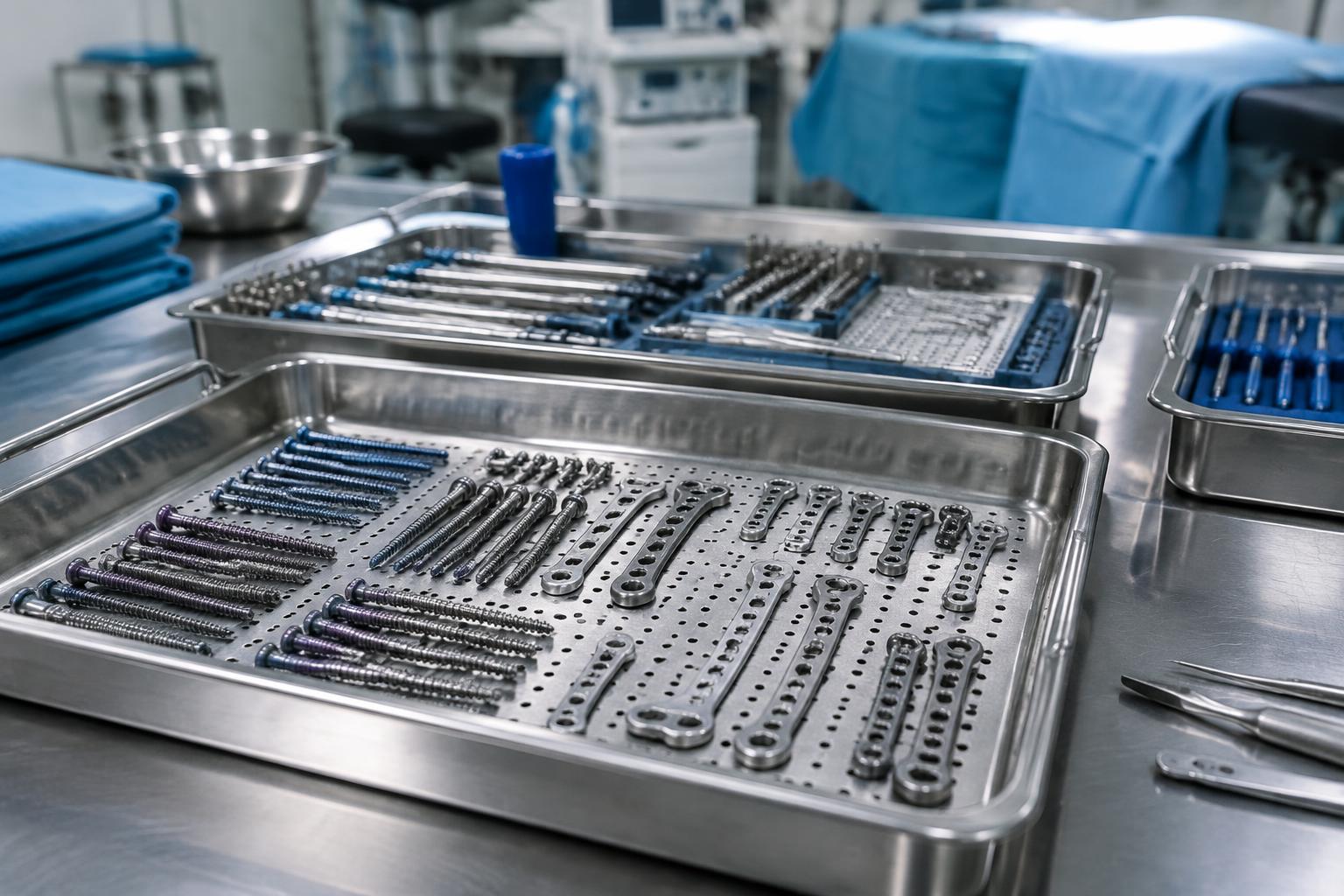
Shoulder, knee, hip and elbow arthroscopy, ligament reconstruction and cartilage restoration.
Hip, knee and shoulder arthroplasty, outpatient and inpatient, with site-of-service and authorization rules applied.
ACDF, TLIF, ALIF, decompression and deformity correction, where one case can carry a dozen codes.
Carpal tunnel release, tendon and nerve repair, small-joint reconstruction and wrist arthroscopy.
Bunionectomy, hammertoe correction, ankle arthroscopy, total ankle replacement and reconstruction.
Fracture fixation, external fixation and polytrauma cases, including split care with modifiers 54 and 55 when patients transfer between surgeons.
Epidural and facet injections, radiofrequency ablation and spinal cord stimulation, with frequency limits tracked per payer.
A large share of orthopedic revenue comes from injured workers and accident victims. These claims follow their own rules and deserve their own workflow.
Nevada workers' comp claims are paid under the Nevada Medical Fee Schedule (NRS 616C.260), which updates every February 1 and uses Relative Values for Physicians along with Nevada-specific codes. We bill insurers and TPAs with the required reports, track authorizations case by case, and file medical bill appeals when payments fall short.
Med-pay, liens and letters of protection, coordinated with attorneys and adjusters, so case-settlement money is not left waiting for years.

When your surgeons operate at a surgery center, the professional claim and the facility claim must tell the same story. We bill both, matching CPT codes, laterality, diagnoses and authorizations so neither claim gets held. See our ASC billing services.

Total joints and spinal fusions are frequent targets for payer audits and recoupments. Our coders audit charts against documentation every quarter, flag both undercoding and overcoding, and build audit-ready packages for high-dollar cases, so your practice is protected before a payer comes knocking.
We bill Medicare Part B through Noridian (Jurisdiction F), Medicare Advantage plans, Nevada Medicaid fee-for-service and managed care plans, and commercial payers including Anthem Blue Cross Blue Shield, UnitedHealthcare and Health Plan of Nevada, Aetna, Cigna, Humana, Hometown Health and Prominence Health Plan. We also bill Nevada workers' comp insurers and TPAs, auto carriers, TRICARE West and VA Community Care.


Las Vegas, Henderson, North Las Vegas, Summerlin, Spring Valley and Enterprise practices, where sports, trauma, workers' comp and auto injury volume run high.

Reno, Sparks, Carson City, Minden and Fallon practices serving a growing Medicare Advantage population and regional health plans.

Elko, Winnemucca, Ely and Pahrump surgeons and outreach clinics, billed remotely with the same specialty depth.
Orthopedic practice anywhere in Nevada? Talk to an orthopedic billing specialist at (631) 652-3106.
Call (631) 652-3106ModMed, athenahealth, eClinicalWorks, NextGen, Epic and AdvancedMD, plus HST Pathways for surgery centers, with secure role-based access and no change to how your surgeons document.
Waystar, Availity and Trizetto for 837P claims, eligibility checks and 835 remittance posting.
Collections per wRVU, procedure mix, denial rate by CPT and payer, global period visit capture, workers' comp aging and underpayment recovery, updated daily and reviewed with your leadership each month.
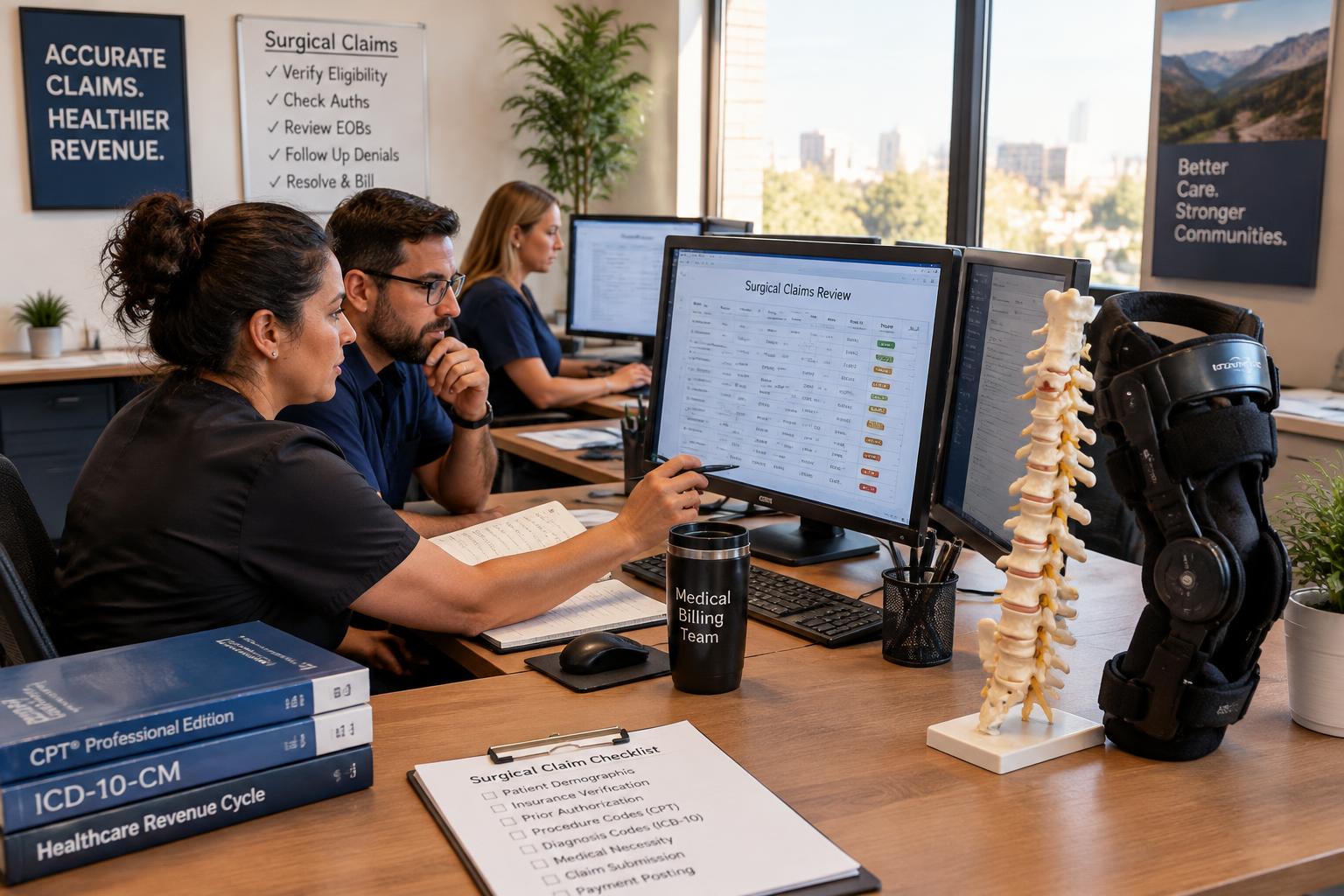



We review 90 days of surgical claims, global period visits and remittances, and quantify the revenue you are missing.
You choose full-cycle billing or targeted services. We sign the BAA and set up role-based access.
We load your contracts, fee schedules, authorization rules and the Nevada workers' comp fee schedule.
Our team works alongside your current billers for two weeks, so no claim falls through the handoff.
Unbilled cases, aged A/R, workers' comp claims and underpayments are worked by dollar value and filing deadline.
Monthly KPI reviews, quarterly coding audits and annual updates for every CPT and CMS change.
What Nevada orthopedic practices see in the first 90 days: In days 1 to 30, operative note charge capture goes live and unbilled cases are cleared. In days 31 to 60, global period corrections, appeals and underpayment recoveries start returning cash. By day 90, workers' comp and lien aging is falling and collections per wRVU are rising.
| Factor | In-house billing team | Nevada Medical Billing |
|---|---|---|
| Certified orthopedic coders | Hard to hire and keep | Coders who work only orthopedic charts |
| Global period and modifier logic | Learned through denials | Built into every claim |
| Workers' comp and liens | Left to age | Worked on their own schedule |
| Underpayment auditing | Rarely done | Every remittance compared with the contract |
| Cost structure | Salaries, benefits, software and training | One fee tied to collections |
See what outsourcing would change for your practice. Book your free orthopedic revenue audit.
You pay for results. We price each engagement around claim volume, procedure mix and payer mix, and quote after reviewing your actual claims.
The standard model for orthopedics. Our fee is a share of net collections, so we grow only when your practice does. Across the industry, outsourced orthopedic billing typically runs between 4% and 8% of net collections.
A fixed fee per claim suits high-volume practices with a stable payer mix.
Keep billing in-house and outsource surgical coding, coding audits, A/R cleanup, workers' comp and lien recovery, or credentialing.
HIPAA compliant · No obligation
Can't find what you need? Our Nevada team answers every question before you commit.
Orthopedic billing services manage the revenue cycle for orthopedic surgeons and practices: surgical and office coding, modifiers, global period tracking, claim submission, payment posting, denial management, workers' comp and patient billing.
Orthopedic claims combine multiple procedures, laterality, global periods, bundling edits, injectables, DME and a high share of workers' comp and accident cases. Each one changes what the claim pays.
Major surgeries carry a 90-day global and minor procedures 0 or 10 days. Routine follow-up is included in the surgical fee, while unrelated care is billed separately with modifiers 24, 58, 78 or 79.
No. Implants and hardware are packaged into the facility payment for the hospital or surgery center. The surgeon bills the professional service only.
The highest-valued procedure pays at 100% and each additional procedure at 50% with modifier 51. Bilateral procedures pay at 150% with modifier 50.
Nevada workers' comp uses the Nevada Medical Fee Schedule under NRS 616C.260, updated every February 1, with Relative Values for Physicians and Nevada-specific codes. Claims go to the employer's insurer or TPA with the required reports.
Yes. We bill professional and ASC facility claims and reconcile codes, laterality, diagnoses and authorizations across both.
Most practices pay a percentage of net collections, typically 4% to 8% across the industry. We quote after the free audit, based on your claim volume and payer mix.
Outsourcing pays off once surgical volume, global periods and authorizations outgrow what in-house staff can track. It also removes the risk of losing your only certified orthopedic coder.
Most practices go live in about 30 days, including system access, payer setup and a two-week parallel launch.
Reviewed by the Nevada Medical Billing Orthopedic Coding Team (CPC and COSC certified coders). Last updated October 2026.
Your surgeons restore movement, strength and independence every day. Make sure your revenue keeps pace. In 30 minutes, we will show you the procedures missing from your claims, the global period visits worth billing and the underpayments still worth recovering.
HIPAA compliant · No obligation · Response within one business day · Prefer to talk? Call (631) 652-3106