Nevada Med Billing logo
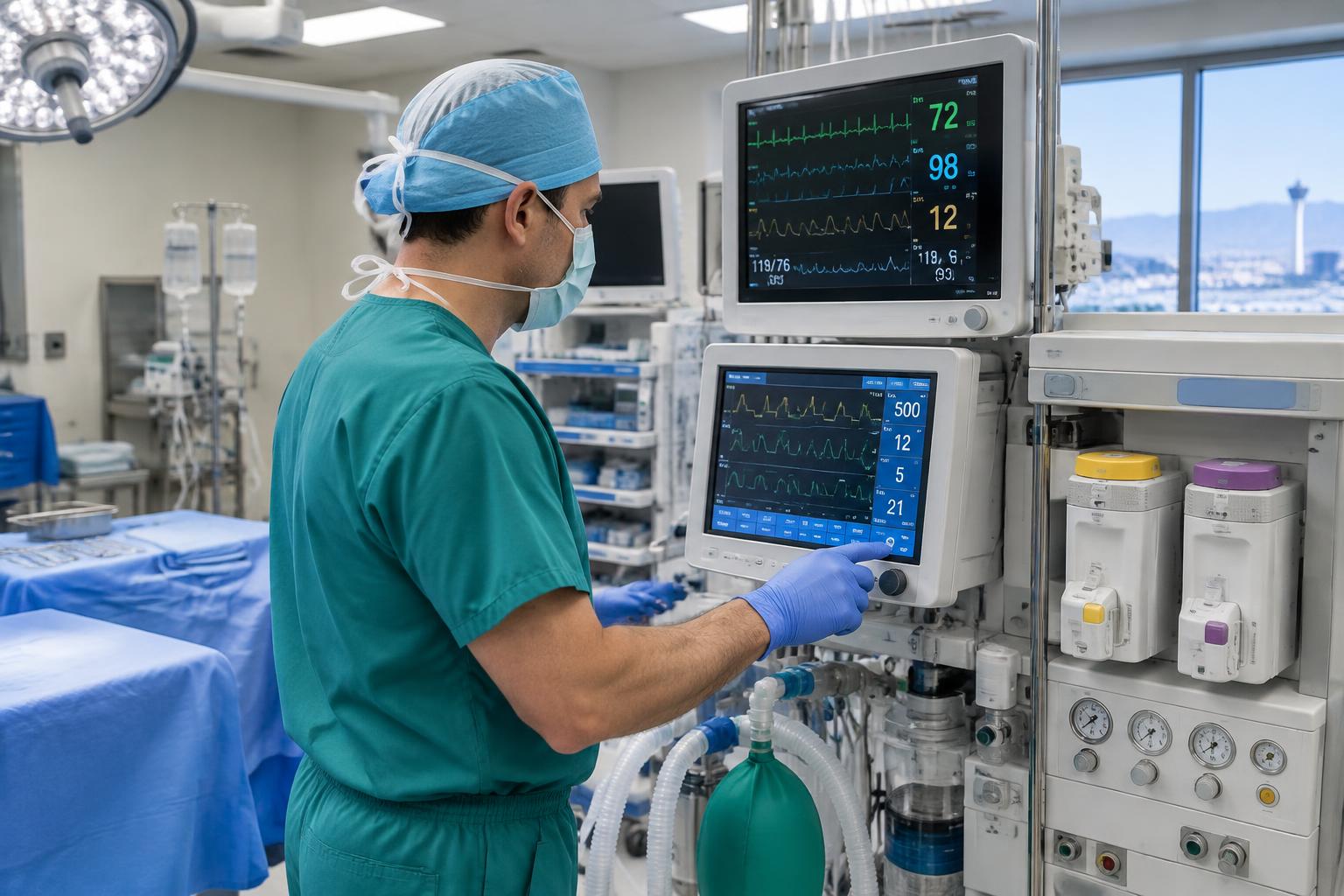
Anesthesiologist preparing an anesthesia workstation in a modern operating room

Anesthesia Billing Services in Nevada for Anesthesiology Groups and CRNAs

Anesthesia billing services are the coding, unit calculation, claim submission and payment recovery work that turn every anesthetic you deliver into fully paid revenue. Nevada Medical Billing provides them for anesthesiologists, CRNAs and anesthesia groups in Las Vegas, Henderson, Reno and statewide, with a 98% first-pass clean claim rate.

Every minute documented. Every unit counted. Every modifier defensible under audit.

  • Certified anesthesia coders (CPC, CANPC)
  • HIPAA compliant with a signed BAA
  • Medicare, Nevada Medicaid and commercial payers
  • Works inside Epic, Plexus, Graphium and iPro
Call (631) 652-3106

We review 90 days of cases, units and remittances and show you exactly where revenue is slipping. No contract. No obligation.

Where Anesthesia Revenue
Quietly Disappears

Your anesthesiologists and CRNAs deliver precise, high-stakes care in every room. Then a few missing minutes, one wrong modifier or a forgotten nerve block erases part of the payment. These seven leaks surface in almost every anesthesia billing audit we perform.

  1. Minutes That Never Reach the Claim

    Anesthesia time begins when the provider starts preparing the patient, not at induction, and it ends when the provider leaves personal attendance. Start the clock late, round down or drop discontinuous time, and you surrender units on every case.

  2. Modifiers That Cut the Payment in Half

    AA pays 100% of the allowable amount; QK, QX and QY pay 50% each. When medical direction is not fully documented, payers reclassify the case as supervision (AD), which pays just 3 base units.

  3. Units You Earned but Never Billed

    Many commercial payers pay extra units for physical status P3 to P5 and for qualifying circumstances such as emergencies and extreme age. If the claim does not ask for them, the payer will not volunteer them.

  4. Blocks and Lines Left Off the Claim

    Postoperative pain blocks, arterial lines, central lines and TEE are separately payable when documented correctly. Generic billers miss them because they code the anesthetic alone.

  5. Cases Missing From the Billing Queue

    Without daily reconciliation against the OR schedule, endoscopy logs and labor and delivery records, cases slip through and never get billed at all.

  6. Conversion Factor Underpayments

    Each payer pays a different dollar amount per unit. When nobody checks remittances against contracted conversion factors, short payments become permanent losses.

  7. Patients Confused by Two Anesthesia Claims

    Care team cases generate a physician claim and a CRNA claim. Patients assume they were double billed, call your office and delay payment.

Find out how many units your claims are leaving behind. Request your free anesthesia revenue audit.

How Anesthesia Billing Works:
The Formula Behind Every Claim

Anesthesia is paid by units, not by a flat procedure fee. Every claim is built from three parts and multiplied by the payer's conversion factor.

(Base units + Time units + Modifying units) × Conversion factor = Payment

Base units reflect the complexity of the anesthesia service. Each surgical CPT code crosswalks to an anesthesia code (00100 to 01999) with a base value from the ASA Relative Value Guide.

Time units come from documented anesthesia minutes. Medicare divides total minutes by 15, while many commercial payers count 15-minute units.

Modifying units are added for physical status and qualifying circumstances by payers that recognize them. Medicare does not.

The conversion factor is the dollar value of one unit. It differs by Medicare locality, Medicaid program and commercial contract.

Worked example: A P3 patient undergoes a procedure with 5 base units and 90 minutes of anesthesia time. With a commercial payer paying $75 per unit, the claim carries 5 base units + 6 time units + 1 physical status unit = 12 units, or $900. Miss 8 minutes and the P3 modifier, and the same case pays less. That gap repeats on every case.

Full-Cycle Anesthesia
Billing and RCM Services

Nevada Medical Billing manages the entire anesthesia revenue cycle or the stages your group wants to hand off. Every workflow is designed for unit-based reimbursement, not borrowed from office billing.

  1. 01

    Charge Capture and Case Reconciliation

    We match every anesthesia record against the OR schedule, endoscopy logs and birthing logs each day, so no case goes unbilled.

  2. 02

    Eligibility and Benefits Verification

    We verify coverage, network status and patient responsibility before scheduled cases, and complete self-pay estimates for elective and cosmetic procedures.

  3. 03

    Anesthesia Coding and Unit Validation

    Certified anesthesia coders crosswalk each surgical procedure, validate base units, calculate time to the minute and apply every modifier the record supports.

  4. 04

    Claim Scrubbing and Submission

    Claims are submitted within 24 to 48 hours of the case after passing payer-specific edits for time, modifiers, concurrency and medical necessity.

  5. 05

    Payment Posting and Conversion Factor Audits

    We post every remittance line and audit it against your contracted conversion factor, time increments and modifier rules. Underpayments go straight to appeal.

  6. 06

    Denial Management and Appeals

    We trace every denial to its root cause, whether time, modifiers, medical direction or medical necessity, then appeal with the anesthesia record and fix the upstream process.

  7. 07

    Patient Billing for Care Team Claims

    Plain-language statements explain why patients receive physician and CRNA charges, online payment is offered, and a dedicated billing line answers questions in your group's name.

  8. 08

    Credentialing and Enrollment

    We enroll anesthesiologists, CRNAs and anesthesiologist assistants with Medicare, Nevada Medicaid and commercial plans, and track revalidation dates so no claim denies for enrollment.

  9. 09

    Provider Documentation Feedback

    Monthly reports on time capture, attestation gaps and units per case give each provider short, specific guidance that lifts revenue without adding charting time.

Anesthesia Billing and Coding
Built on Precision

Anesthesia billing leaves no margin for error. Our coders read the full anesthesia record, including times, attestations, drugs and monitoring, before a claim leaves our hands.

ASA Crosswalk and Base Units

We map each surgical CPT code to the correct anesthesia code and confirm the base value against the current ASA Relative Value Guide, including when a more specific code pays more.

Time Capture to the Minute

We count from the start of patient preparation to the end of personal attendance, add discontinuous blocks of time and convert minutes the way each payer requires.

Care Team and MAC Modifiers

Anesthesia Billing and Coding Built on Precision
ModifierMeaningPayment effect
AAAnesthesiologist personally performed100% of the allowable amount
QYAnesthesiologist directs one CRNA50% to each provider
QKAnesthesiologist directs 2 to 4 concurrent cases50% to the physician
QXCRNA or AA with medical direction50% to the CRNA or AA
QZCRNA without medical direction100% of the CRNA allowable amount
ADSupervision of more than 4 concurrent cases3 base units, plus 1 with induction presence
QSMonitored anesthesia careRequires documented medical necessity
G8 / G9MAC for complex procedures or severe cardiopulmonary historySupports medical necessity for MAC
GCTeaching anesthesiologist with residentsFull payment for 1 or 2 concurrent resident cases
23 / 47Unusual anesthesia / anesthesia by surgeonPayer-specific

Medical Direction Compliance

For every QK and QY case, we confirm the 7 TEFRA steps: the pre-anesthetic exam, the anesthesia plan, personal participation in the most demanding parts including induction and emergence, qualified staff for the remaining parts, frequent monitoring, immediate physical availability and post-anesthesia care. A missing step turns a directed case into supervision, so we catch it before the payer does.

Physical Status and Qualifying Circumstances

We apply P1 to P6 on every claim and bill qualifying circumstance codes 99100, 99116, 99135 and 99140 to payers that pay them, while keeping Medicare claims clean of units it does not pay.

Separately Billable Anesthesia
Services We Capture

The anesthetic is only part of the story. These services pay on their own when documented correctly.

Postoperative Pain Blocks and Catheters

Peripheral nerve blocks (64415 to 64448), fascial plane blocks such as erector spinae, quadratus lumborum and iPACK, continuous catheters and epidurals (62320 to 62327), billed with 59 or XU when the surgeon requests them for postoperative pain and they are not the primary anesthetic. Daily catheter management is billed with 01996.

Invasive Lines and Monitoring

Arterial lines (36620), central venous catheters (36556), transesophageal echocardiography (93312 to 93318) and ultrasound guidance (76937, 76942), each supported by its own documentation.

Obstetric Anesthesia

Labor epidurals (01967), cesarean add-ons (01968) and cesarean hysterectomy (01969), with payer-specific rules for counting labor time and daily reconciliation against birthing logs.

Cancelled Cases and Pre-Anesthesia Evaluations

When a case is cancelled after the pre-anesthesia evaluation but before induction, we bill the evaluation as an E/M service so the work is still paid.

Anesthesia Billing
for Every Practice Setting

Hospital Anesthesia Billing

Main OR, labor and delivery, cardiac and EP labs, interventional radiology and other non-operating-room sites, with stipend and coverage reporting for hospital contract talks.

ASC Anesthesia Billing

High-volume, fast-turnover orthopedic, ophthalmology, GI and pain cases, reconciled daily against the surgery center schedule.

GI and Endoscopy Anesthesia

MAC and deep sedation for colonoscopy and EGD (00811 to 00813), with correct screening coding so patients keep their zero cost share and claims do not deny.

Office-Based, Dental and Cosmetic Anesthesia

Plastic surgery, oral surgery and office-based procedures, with self-pay estimates, prepayment collection and clean documentation for any insured portion.

CRNA and Anesthesia
Care Team Billing

Your staffing model decides your modifiers, your documentation and your payment. We bill each model the way payers expect.

Anesthesiologist-Only Groups

Personally performed cases (AA) with time and units maximized and teaching cases billed with GC.

Medically Directed Care Teams

Anesthesiologist and CRNA or AA claims billed in pairs (QK or QY with QX), with concurrency tracked across rooms and attestations checked case by case.

Independent CRNA Practices

CRNA services billed with QZ where state law, Medicare supervision rules and facility bylaws allow it. We confirm the supervision requirement at each Nevada facility before the first claim.

Hybrid and Multi-Site Groups

One set of rules across hospitals, ASCs and offices, with dashboards by site, provider and payer.

Out-of-Network Anesthesia
and Payer Contract Support

No Surprises Act Recovery

Anesthesia at an in-network facility is protected by the federal No Surprises Act, so patients cannot be balance billed. We dispute low initial payments through 30-business-day open negotiation and independent dispute resolution, with evidence that challenges the payer's qualifying payment amount.

Contract and Conversion Factor Analysis

We benchmark your conversion factors, time increments and modifier recognition by payer, then hand your leadership the data needed to negotiate better terms.

Stipend and New Facility Projections

Before you staff a new hospital or surgery center, we project collections from its payer mix and case volume, so you know whether to ask for a stipend.

MIPS Quality Reporting
for Anesthesia Groups

We capture quality data from your anesthesia records and report anesthesia measures such as perioperative temperature management, PONV prevention, multimodal pain management and smoking abstinence, protecting your Medicare payments from MIPS penalties.

Insurance Payers We Bill
for Nevada Anesthesia Providers

We bill Medicare Part B through Noridian (Jurisdiction F), Medicare Advantage plans, Nevada Medicaid fee-for-service and managed care plans, and commercial payers including Anthem Blue Cross Blue Shield, UnitedHealthcare and Health Plan of Nevada, Aetna, Cigna, Humana, Hometown Health and Prominence Health Plan. We also handle TRICARE West, VA Community Care and Nevada workers' compensation claims.

Anesthesia Billing
Services Across Nevada

Las Vegas and Clark County, Nevada

Las Vegas and Clark County

Las Vegas, Henderson, North Las Vegas, Summerlin, Spring Valley and Enterprise hospitals, surgery centers and office-based practices, where high case volume and tight payer contracts reward fast, accurate billing.

Reno, Sparks and Northern Nevada, Nevada

Reno, Sparks and Northern Nevada

Reno, Sparks, Carson City, Minden and Fallon, where regional health plans and a growing Medicare Advantage population make payer-specific rules critical.

Anesthesia group anywhere in Nevada? Talk to an anesthesia billing specialist at (631) 652-3106.

Call (631) 652-3106

Technology and AIMS
Integration

Anesthesia Information Management Systems

Epic Anesthesia, Oracle Health SurgiNet, Plexus Anesthesia Touch, Graphium and iPro, with secure daily data pulls and no change to how your providers chart.

Clearinghouse and Payer Connectivity

Waystar, Availity, Trizetto and payer portals for 837P claims, eligibility checks and 835 remittance posting.

Anesthesia Revenue Dashboards

Collections per case, units per case, time capture by provider, modifier mix, denial rate by payer, days in A/R and underpayment recovery, updated daily and reviewed with your leadership each month.

Anesthesiology practice team reviewing billing and collections
  • Waystar
  • Availity
  • TriZetto

How Our Anesthesia
Billing Process Works

  1. Free anesthesia revenue audit

    We review 90 days of cases, units, modifiers and remittances and quantify the revenue you are missing.

  2. Custom plan and BAA

    You choose full-cycle billing or targeted services. We sign the BAA and set up role-based access.

  3. Payer and rules setup

    We load your conversion factors, time rules, modifier logic and facility schedules.

  4. Parallel launch

    Our team works alongside your current billers for two weeks, so no case falls through the handoff.

  5. Backlog recovery

    Unbilled cases, aged A/R and open underpayments are worked by dollar value and filing deadline.

  6. Ongoing performance reviews

    Monthly KPI reviews, provider feedback and annual updates for every ASA, CPT and CMS change.

Anesthesia Billing
Results You Can Measure

  • 98%

    clean claim rate on first submission

  • 99%

    accuracy on base units, time units and modifiers

  • <30

    days in A/R for most groups within six months

  • 97%

    net collection rate on contracted claims

  • 90%

    of appealed denials overturned

  • 8

    to 12% increase in collections per case in year one

What Nevada anesthesia groups see in the first 90 days: In days 1 to 30, daily case reconciliation goes live and unbilled cases are cleared. In days 31 to 60, conversion factor audits and appeals start returning underpaid dollars. By day 90, time capture and modifier accuracy show up as higher collections per case.

Outsourced Anesthesia
Billing vs an In-House Team

Outsourced Anesthesia Billing vs an In-House Team
FactorIn-house billing teamNevada Medical Billing
Certified anesthesia codersRare and hard to keepCoders who work only anesthesia records
Medical direction complianceChecked after denialsChecked on every case before submission
Conversion factor auditingRarely doneEvery remittance line compared with the contract
Coding updatesLearned the hard wayLoaded before effective dates
Cost structureSalaries, benefits, software and trainingOne fee tied to collections

See what outsourcing would change for your group. Book your free anesthesia revenue audit.

Flexible Pricing for Anesthesia
Billing Services

You pay for results. We price each engagement around case volume, payer mix and the services you need, and we quote after reviewing your actual claims.

Percentage of Collections

The standard model for anesthesia. Our fee is a share of net collections, so we grow only when you do. Across the industry, outsourced anesthesia billing typically runs between 4% and 8% of net collections.

Per-Case Pricing

A fixed fee per billed case suits high-volume groups with a stable payer mix.

Coding-Only and Targeted Services

Keep billing in-house and outsource only anesthesia coding, A/R cleanup, underpayment recovery, No Surprises Act disputes or credentialing.

HIPAA compliant · No obligation

Anesthesiology practice team reviewing billing and collections

Anesthesia Billing
Services FAQs

Can't find what you need? Our Nevada team answers every question before you commit.

Anesthesia billing services cover the revenue cycle for anesthesia providers: case capture, crosswalk coding, time and unit calculation, modifiers, claim submission, payment posting, denial management and patient billing.

Payment equals base units plus time units plus any modifying units, multiplied by the payer's conversion factor. Base units come from the ASA Relative Value Guide, and time units come from documented anesthesia minutes.

Anesthesia time starts when the provider begins preparing the patient for anesthesia and ends when the provider is no longer in personal attendance, usually at the safe transfer of care to recovery.

Medical direction means an anesthesiologist directs up to 4 concurrent cases and completes all 7 TEFRA steps for each one. Supervision covers more than 4 concurrent cases, or cases where the steps are not met, and pays far less.

No. Medicare pays no extra units for P1 to P6 or qualifying circumstances, although the physical status modifier still belongs on the claim. Many commercial payers do pay them, which is why we bill them wherever the contract allows.

Yes, when the block is for postoperative pain, requested by the surgeon and not the primary anesthetic. It is billed with its own CPT code and modifier 59 or XU.

CRNA services are billed with QX when medically directed and QZ when the CRNA works without medical direction. In a directed case, the physician and the CRNA each receive 50% of the allowable amount.

In care team cases, the anesthesiologist and the CRNA each submit a claim. Together they equal roughly what a single provider would be paid, and our patient statements explain this clearly.

Most groups pay a percentage of net collections, typically 4% to 8% across the industry. We quote after the free audit, based on your case volume and payer mix.

Most groups go live in about 30 days, including system access, payer setup and a two-week parallel launch.

Reviewed by the Nevada Medical Billing Anesthesia Coding Team (CPC and CANPC certified coders). Last updated October 2026.

Get Your Free Anesthesia
Revenue Audit

Your providers protect patients through the most vulnerable minutes of their care. Let us protect the revenue those minutes earn. In 30 minutes, we will show you your units per case, your modifier accuracy and the underpayments still worth recovering.

HIPAA compliant · No obligation · Response within one business day · Prefer to talk? Call (631) 652-3106

Practice settings
Please don't include any patient information.