

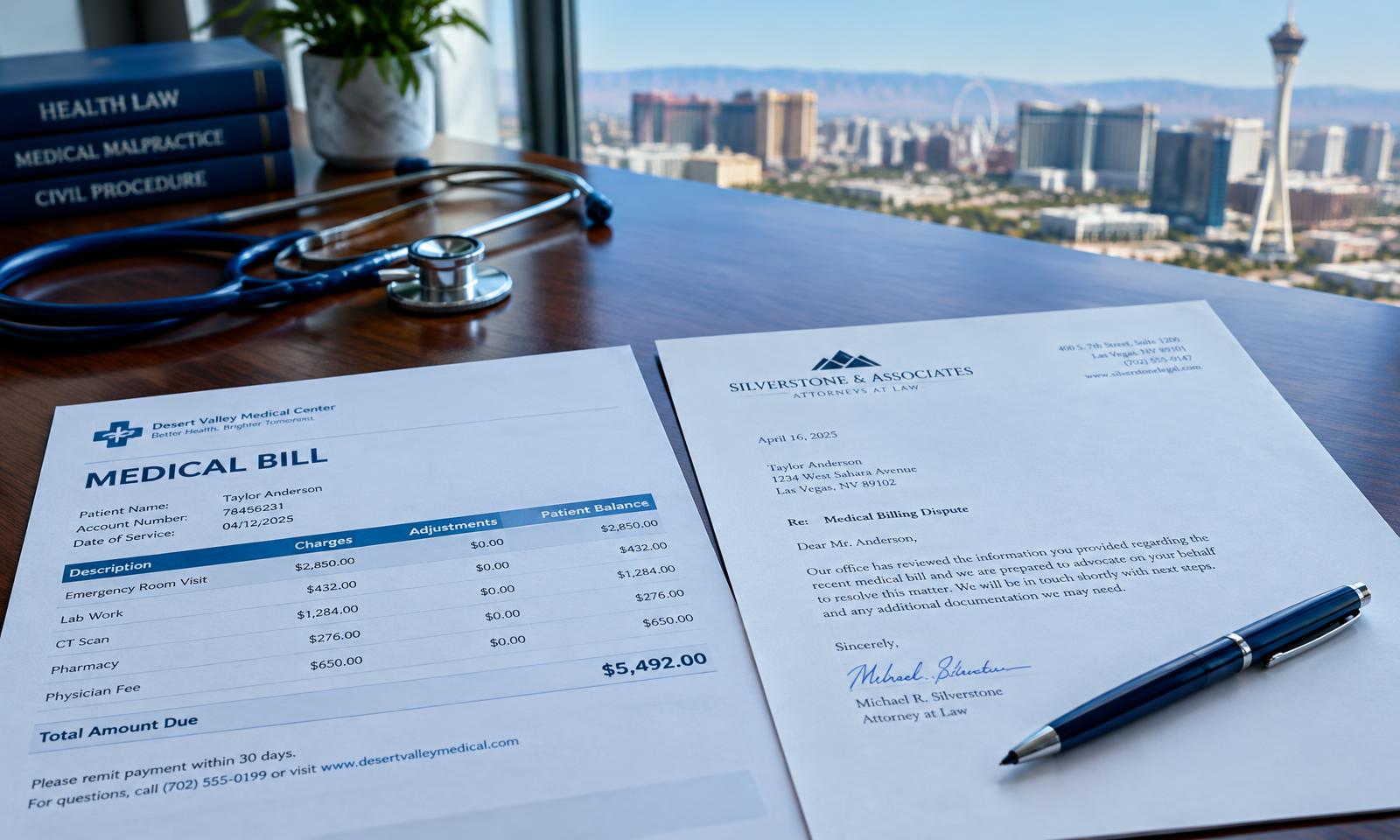
A medical lien gives a provider a right to be paid out of a patient's personal injury recovery. In Nevada, hospitals get that right by statute under NRS 108.590, but only if they record and serve a notice of lien correctly. Physicians, chiropractors, physical therapists and imaging centers usually rely on a contract instead: a lien agreement or a letter of protection (LOP) signed with the patient's attorney.
Both tools let an injured patient get care now and pay when the case resolves. Both also carry rules that decide whether the provider is paid in full, paid in part, or left chasing a balance. This guide walks through those rules as they apply in Nevada, from the billing side of the desk. It is part of our Nevada billing law library.
What a medical lien is, and what a letter of protection is
A medical lien is a claim against money the patient receives from an at-fault party, whether by judgment, settlement or compromise. The lien follows the money. When the liability insurer pays, the lienholder has a right to be paid from those funds before the patient takes the rest.
A letter of protection is a promise, usually written on the attorney's letterhead, that the provider's bill will be paid from any recovery. The patient signs it too. It is not a statute; it is a contract, so its terms decide what happens if the case goes sideways.
Statutory liens vs contractual liens
Nevada sorts injury-related medical claims into two families. Statutory liens exist because a law creates them: the hospital lien in NRS Chapter 108, the Medicaid lien in NRS 422.293, and the workers' compensation lien in NRS 616C.215. Contractual liens exist because the patient agreed to them: LOPs, physician lien agreements, and the reimbursement clause in most health plans.
The difference matters at payout. A statutory lien that is properly perfected binds the liability insurer, not just the patient. A contractual lien mostly binds the patient and, through the LOP, the attorney who signed it.
Lien, LOP and regular bill compared
| Hospital lien (NRS 108.590) | Letter of protection | Regular medical bill | |
|---|---|---|---|
| Source of the right | Statute | Contract | Patient's account |
| Who signs | No one; hospital records it | Patient, attorney, provider | Patient at intake |
| Binds the at-fault insurer | Yes, once served | No | No |
| Attorney must hold funds | Yes, once on notice | Yes, by the LOP's terms | Generally no |
| Patient owes if case is lost | Account remains due | Usually, per the contract | Yes |
| Typical holders | Hospitals | Chiropractors, PT, pain management, surgeons, imaging | Any provider |
Who can hold a lien on a Nevada injury recovery
In a typical Clark County or Washoe County auto case, a closing statement can list five or more claimants:
- Hospitals and ER physician groups, through the Chapter 108 statutory lien.
- Treating providers on LOPs or lien agreements: chiropractors, physical therapists, orthopedic and spine surgeons, pain management, imaging centers, and ambulance services.
- Nevada Medicaid, which is subrogated to the patient's claim for anything it paid.
- Medicare, which pays conditionally and must be repaid from the recovery.
- Health plans, including self-funded employer plans, through their reimbursement clauses.
- Workers' compensation carriers, when the injury happened on the job and a third party caused it.
- The patient's attorney, whose fee and case costs come off the top under the fee agreement.
A lien funding company can also appear on that list. It does not treat anyone; it bought the receivable from a provider. More on that below.
How a Nevada hospital lien works under NRS 108.590
What the lien attaches to and what it cannot exceed
When a person is hospitalized for an injury and claims damages from whoever caused it, the hospital has a lien on any sum the patient recovers by judgment, settlement or compromise. The lien is limited to the reasonable value of hospital care given before that judgment or settlement (NRS 108.590).
Two limits are easy to miss. First, the word is "reasonable value," not "billed charges," which gives attorneys room to challenge a chargemaster rate. Second, the lien does not reach anyone covered by Nevada's workers' compensation chapters.
Perfecting the lien: recording and service
A hospital lien is only as good as its paperwork. Under NRS 108.610, the hospital must do three things:
- Before any money is paid to the patient or their attorney, record a notice of lien with an itemized statement of the amount claimed.
- File that notice with the county recorder where the hospital sits, and also where the injury happened if that is a different county.
- Before judgment or settlement, serve a certified copy by registered or certified mail on the person who caused the injury and on that person's liability insurer, if known.
Note who gets served: the at-fault party and its insurer. A notice mailed only to the patient does not perfect the lien. When we audit a hospital lien for a client, the recording date and the certified-mail receipts to the carrier are the first two documents we pull.
Patients with health insurance: the 90-day notice of intent
Nevada does not let a hospital quietly skip a contracted health plan to chase a larger lien. If the patient has health coverage through a plan the hospital contracts with, and the hospital wants to keep its lien rights, NRS 108.605 requires a notice of intent to file a lien. It goes by registered or certified mail within 90 days after discharge, to the liability insurer and to the patient and their attorney.
Within 30 days of sending that notice, the hospital must start collection under Nevada's hospital billing rules in NRS 449A.159. If it does not, the notice is void from the start. Medicaid, Medicare and CHIP patients are carved out of this section because they have their own limit.
The 55% cap for Medicaid- and Medicare-eligible patients
If the injured person may be eligible for Medicaid, Medicare, CHIP or another public program that could pay the bill, the hospital cannot collect more than 55% of its billed charges through the lien (NRS 108.655). On a $60,000 ER and inpatient bill, the lien ceiling is $33,000.
Billed charges
$60,000
Lien ceiling at 55%
$33,000
The trigger is possible eligibility, not enrollment. Billing teams should screen for it at registration, because a lien filed at 100% of charges for an eligible patient invites a dispute the hospital will lose.
What happens if the insurer pays and ignores the lien
This rule is the reason perfection matters. Under NRS 108.650, an insurer or person who receives the certified notice and then pays the patient or their attorney without paying the hospital stays liable to the hospital for 180 days after that payment. The hospital can sue the payer in any county where the lien was filed.
The same section sets the order: the hospital is paid after the attorney's fees, costs and any prior liens. That is why hospital lien balances are often negotiated against what is left, not against the gross settlement.
How letters of protection work in Nevada
Nevada has no statute that governs LOPs. They run on contract law and on the attorney's duty to safeguard money that belongs to others. Under Nevada's version of Rule of Professional Conduct 1.15, a lawyer who knows a third party has a claim to funds must protect them, and disputed amounts stay in trust until the dispute is resolved.
What a well-drafted LOP says
From a billing standpoint, a usable LOP answers six questions in writing:
- Which patient, which date of injury, and which claim it covers.
- That the attorney will hold the provider's balance from any recovery and pay it before distributing funds to the client.
- Whether the patient remains personally liable if there is no recovery, or a short one.
- What happens if the attorney withdraws or the patient changes lawyers. A good LOP binds substitute counsel or requires notice.
- Whether the provider will accept a reduction and who must approve it.
- How often the attorney will give a case status update, such as every 90 days.
If the case is lost or the attorney withdraws
An LOP defers payment; it does not usually forgive it. If the claim fails, most agreements leave the full balance with the patient, and the provider can bill and collect like any other account. Patients should read that clause before signing. Providers should decide in advance whether they will offer a hardship reduction, because a balance that was "waiting on the settlement" for two years is hard to collect cold.
Watch the clock as well. Nevada's general statute of limitations for personal injury is two years, so an LOP account on a case where no suit has been filed after about 18 months is a risk flag worth a call to the attorney.
Government and insurer liens: Medicaid, Medicare, health plans and workers' comp
Nevada Medicaid. When Medicaid pays for injury care, the state is subrogated to the patient's claim and holds a lien on the recovery under NRS 422.293. The lien is not enforceable until written notice goes to the patient or their attorney, and the attorney must keep Medicaid informed as the claim moves toward settlement. The Director can reduce the lien to reflect the attorney's work in producing the recovery. Providers who billed Medicaid generally cannot also take a lien for the same services; that is the state's claim to make.
Medicare. Medicare pays injury claims on a conditional basis and must be repaid once a liability settlement exists. After settlement, CMS issues a final demand, reduces it pro rata for attorney's fees and costs under 42 C.F.R. 411.37, and expects payment within 60 days, after which interest runs. Parties within 120 days of settlement can use the Final Conditional Payment process to lock the amount. Paying the client before Medicare is resolved exposes both the client and the attorney.
Health plans. Most health plans include a reimbursement clause. Fully insured plans are subject to Nevada insurance law. Self-funded employer plans governed by federal ERISA often enforce their plan language as written, which makes them harder to reduce.
Workers' compensation. If a third party injured a worker on the job, the comp carrier has a lien on the third-party recovery under NRS 616C.215. Nevada's rules changed twice in under a year. In late 2024, AmTrust North America v. Vasquez overruled the long-used Breen formula. Then SB 258, effective May 31, 2025, capped the carrier's lien at the lesser of the lien (after cost sharing) or one-third of the total recovery, and cut the lien by half the worker's reasonable costs of pursuing the claim. Hospital liens under Chapter 108 do not apply in workers' comp cases at all.
Liens at trial: bias evidence and the collateral source rule
Nevada follows a strict collateral source rule. Since Proctor v. Castelletti (1996), juries generally may not hear that a plaintiff's bills were paid by insurance or another outside source.
Liens are treated differently. In Khoury v. Seastrand (2016), the Nevada Supreme Court held that a lien is not a collateral source, because the patient still owes the bill. The court said the trial judge should have let the defense show that treating providers worked on liens, since that can show a financial stake in the outcome. It upheld exclusion of the price a funding company paid to buy those liens.
For providers, the practical point is simple. If you treat on a lien and testify, expect the defense to ask about it. Clean records, coded and itemized bills, and charges in line with your usual rates are your best answer.
Lien sales and NRS 629.078
Many Nevada providers sell lien receivables to funding companies at a discount to get paid sooner. That is lawful in itself. What Nevada bans is a narrower practice: a provider who treats a patient with a pending injury claim, or a business that provider has a financial interest in, may not buy or acquire a lien for services that another provider gave the same patient on the same claim (NRS 629.078).
The penalty is a category E felony and a fine of up to $25,000 per violation. "Financial interest" is defined broadly, including any ownership share, profit share or compensation tied to the debt. Any practice with a stake in a lien funding company should have counsel review that arrangement.
How liens are paid from a Nevada settlement
Settlement funds go into the attorney's trust account, and nothing goes to the client until liens are resolved. The usual order is attorney's fees and case costs, then medical liens and reimbursement claims, then the client's net recovery. The hospital-lien statute reflects the same order.
- Step 1
Attorney's fees and case costs
- Step 2
Medical liens and reimbursement claims
- Step 3
Client's net recovery
Worked example
A hypothetical $100,000 auto settlement resolved before a lawsuit is filed, using the most common Nevada fee structure: 33 1/3% pre-litigation, rising to 40% once suit is filed (your client's fee agreement controls):
| Line item | Billed or claimed | After negotiation |
|---|---|---|
| Gross settlement | $100,000 | $100,000 |
| Attorney's fee (33⅓%) | –$33,333 | –$33,333 |
| Case costs (records, postage; no suit filed) | –$1,500 | –$1,500 |
| Hospital lien (NRS 108.590) | –$32,000 | –$24,000 |
| Chiropractic LOP | –$9,500 | –$7,600 |
| MRI center LOP | –$3,200 | –$2,700 |
| Client net recovery | $20,467 | $30,867 |
Client net, liens as billed
$20,467
Client net, after negotiation
$30,867
Lien reductions of $10,400 raised the client's net by about 51%. Had the case gone into litigation at 40%, the fee alone would rise to $40,000 and costs typically climb too, which shrinks the pool liens are paid from. That is why reduction requests are routine, and why providers who can show their charges are reasonable negotiate from a stronger position.
If liens and fees exceed what is available, the attorney must hold the disputed amount. When lienholders cannot agree, the attorney can ask a court to divide the funds through an interpleader action.
Running lien accounts as a provider: a billing checklist
Lien work pays well when it is tracked like a receivable, not filed like a hope. This is the workflow that holds up for most practices doing personal injury lien billing, whatever billing system you use:
- At intake, capture the date of injury, claim type (auto, premises, work), attorney, liability carrier and claim number, and screen for Medicaid, Medicare and health coverage.
- Choose the right tool. Hospitals: record and serve the Chapter 108 lien, or send the 90-day notice of intent for contracted health plans. Other providers: get a signed LOP or lien agreement before the first visit.
- Bill clean. Itemize every service with CPT and ICD-10 codes on standard claim forms, at the same rates you charge everyone else.
- Keep a lien ledger. One line per patient: balance, LOP date, attorney, last status update, suit filed (yes/no), and limitations date.
- Request status every 60–90 days. Flag files with no suit filed at 18 months and any change of attorney.
- Set a reduction policy in advance. Decide who can approve reductions and the floor for each payer type, so you can answer within a week of a request.
- Reconcile at payout. Match the check to the agreed amount, close the account, and issue a zero-balance statement to the patient.
- Escalate disputes. If the attorney disburses without paying a perfected hospital lien, the 180-day payer liability window under NRS 108.650 is your clock.
If your practice treats injured patients on liens and wants a team that tracks every balance to payout, see our personal injury lien billing service.
Frequently asked questions
Is a letter of protection the same as a medical lien in Nevada?
Not quite. A hospital lien is created by NRS 108.590 and binds the at-fault insurer once served. An LOP is a contract between patient, attorney and provider. Both are paid from the recovery, but only the statutory lien gives the provider a claim against the payer.
Does a Nevada hospital lien need my signature?
No. The hospital creates it by recording a notice of lien and serving the at-fault party and its insurer. If you have a contracted health plan, the hospital must also send you a notice of intent within 90 days of discharge.
Can a hospital file a lien instead of billing my health insurance?
Only within limits. If the hospital is contracted with your plan, it must send a notice of intent and pursue collection under state hospital billing rules within 30 days, or the notice is void.
How much can a hospital lien be if I have Medicaid or Medicare?
No more than 55% of billed charges if you may be eligible for Medicaid, Medicare, CHIP or another public program (NRS 108.655).
Do I still owe my doctor if I lose my injury case?
Usually, yes. Most LOPs and lien agreements defer payment rather than cancel it. Read the agreement's no-recovery clause before signing.
Can medical liens be negotiated down?
Yes. Reductions are common, especially when the settlement is small relative to the bills or the charges exceed reasonable value. Medicaid and Medicare have their own reduction rules.
Can my doctor sell my lien?
Generally yes; funding companies buy lien receivables. Nevada bans a provider, or a business it has a financial interest in, from buying liens for another provider's services on the same claim.
Can the jury learn that I treated on a lien?
Often, yes. Under Khoury v. Seastrand, the defense may show a lien to suggest a treating provider has a stake in the outcome. The price a funder paid for the lien was excluded.
How long does a workers' comp carrier's lien reach in a third-party case?
After SB 258, the lien is capped at the lesser of the reduced lien or one-third of the total recovery, and reduced by half of your reasonable costs of pursuing the claim.